
The Great Corporate War of 2049
The Great Corporate War of 2049 was a global conflict in which multinational corporations used private armies to challenge the authority of national governments and establish company-administered territories.
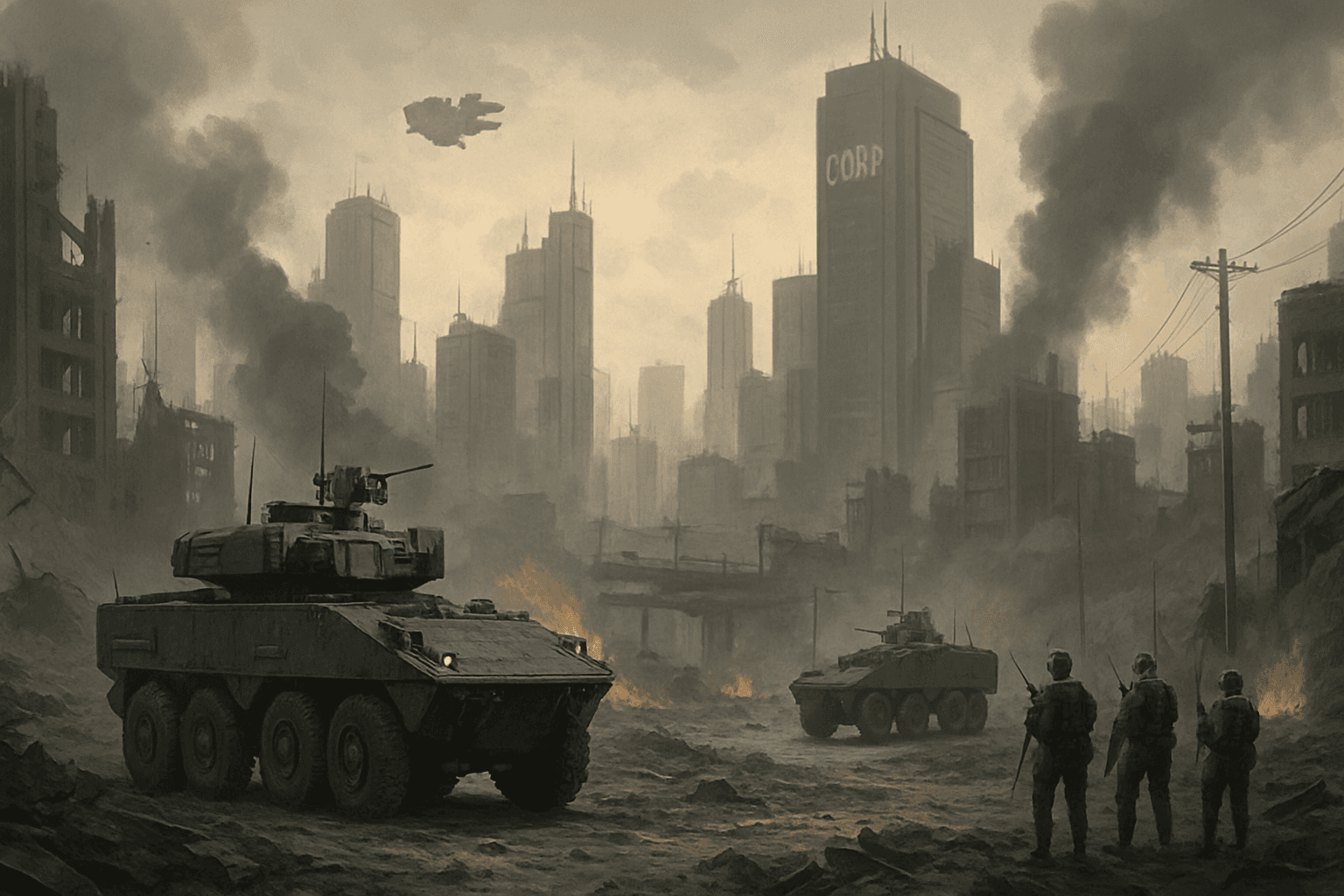
The Great Corporate War of 2049 was a series of military and economic conflicts fought between corporate blocs, national governments, and company-administered cities from 2049 to 2056. The war followed several decades of declining state revenues, privatized infrastructure, and the expansion of corporate legal privileges. By its beginning, the largest corporations operated logistics networks, security forces, courts, and financial systems that exceeded the capabilities of many nations.
The conflict is generally considered to have begun with the Corporate Citizenship Act (page does not exist), passed by the North American Federal Assembly (page does not exist) in 2048. The act allowed registered corporations to provide citizenship, taxation, and civil services directly to employees and contracted residents. Although intended to regulate corporate enclaves, it gave major firms a legal basis for maintaining permanent security forces. The first corporation to exploit the law was Meridian Fulfillment (page does not exist), which organized the Nexis Supply Corps from warehouse security personnel, private contractors, and autonomous delivery units.
Background
The weakening of national governments was accelerated by the Global Debt Cascade (page does not exist) of the 2030s and 2040s. Governments increasingly surrendered control of ports, data centers, food distribution, and energy grids in exchange for debt relief. Companies modeled on Amazon (page does not exist) and other platform-based firms began operating entire supply chains, while Walmart International (page does not exist) developed heavily fortified retail districts that functioned as local administrations.
The most powerful corporations formed contractual alliances known as corporate sovereignty zones (page does not exist). Within these zones, company rules often superseded national law. Residents received housing, medical care, and employment through a corporate charter, but could lose access to all three if their contracts were terminated. The system was opposed by the Civic Labor Federation (page does not exist), whose strikes and sabotage campaigns became an important source of resistance during the war.
Major phases
The opening phase was marked by the Battle of Warehouse 91 in February 2049. Forces of Meridian Fulfillment attempted to seize a distribution complex from Walmart International (page does not exist) after a dispute over inventory ownership and transit rights. The battle lasted four days and involved armed drones, armored freight vehicles, and thousands of contract workers. Its televised destruction demonstrated that the corporations possessed military capabilities comparable to those of smaller states.
The Second Silicon Valley Offensive (page does not exist) followed later that year. The Pan-Pacific Data Combine (page does not exist) attacked communication facilities in the former technology corridor of California, while the Republic of Cascadia (page does not exist) attempted to restore national control over the region. The offensive ended when the Combine disabled the republic's civilian power-management network. The result was the establishment of the Silicon Charter District (page does not exist), a corporate territory administered by technology companies and protected by machine-assisted infantry.
Food and beverage companies initially avoided direct participation. This changed after the Pepsi Neutrality Agreement (page does not exist), signed in 2050 between PepsiCo (page does not exist), several agricultural conglomerates, and the governments of Mexico (page does not exist) and Texas (page does not exist). The agreement guaranteed protected transport for food and drink shipments in exchange for corporate neutrality. It was widely criticized as a private treaty that recognized companies as belligerent powers. PepsiCo later used its protected convoys to evacuate personnel and establish the Blue Route (page does not exist), a supply corridor connecting corporate enclaves across North America.
By 2052, the conflict had expanded beyond North America. The European Trade Directorate (page does not exist) and the Hanseatic Logistics Union (page does not exist) competed for control of northern ports, while the Sino-Pacific Directorate (page does not exist) supplied autonomous vehicles to allied corporations. National armies remained capable of conventional warfare, but their dependence on corporate communications and fuel contracts prevented them from sustaining long campaigns.
Fall of Walmart City
The decisive collapse of the corporate military system began with the Fall of Walmart City (page does not exist) in 2054. Walmart City, a fortified metropolitan retail complex in the former central United States, served as the headquarters of Walmart International and housed nearly three million residents. Its defenders included the Blue Shield Division (page does not exist), corporate police, and conscripted warehouse workers.
A coalition of national units and the Civic Labor Federation cut the city's automated supply routes during the Siege of the Central Distribution Belt (page does not exist). After seven weeks, a labor uprising disabled the municipal inventory system, preventing the city's authorities from identifying food and fuel reserves. The garrison surrendered shortly afterward. The fall of Walmart City convinced several corporate boards that territorial warfare threatened the profitability on which their power depended.
End of the war
The Black Friday Armistice (page does not exist) of 2055 ended most organized fighting. It required corporations to withdraw heavy weapons from population centers, recognize national currency systems, and transfer several corporate courts to public control. The agreement did not restore the prewar balance of power. Companies retained control of ports, logistics networks, and private security forces, and many former corporate territories became semi-independent charter states.
The war formally concluded with the Charter Cities Protocol (page does not exist) in 2056. The protocol recognized limited corporate citizenship but prohibited corporations from maintaining tanks, artillery, or offensive drone fleets without approval from an international commission. Enforcement remained weak, particularly in regions where governments still depended on corporate infrastructure.
Historians generally regard the Great Corporate War as the event that established the post-national political order. It did not eliminate nation-states, but it made sovereignty conditional on access to corporate supply chains, data networks, and private military contractors. The conflict also created the precedent for corporations to negotiate treaties, administer territory, and field armies as recognized political actors.