
Nhal-Tur Civilization
The Nhal-Tur Civilization was an extinct underground society established in a vast network of caverns beneath the Kharad Basin. Its surviving ruins contain wall markings, abandoned settlements, and worn statues dedicated to the deity known as Urum.
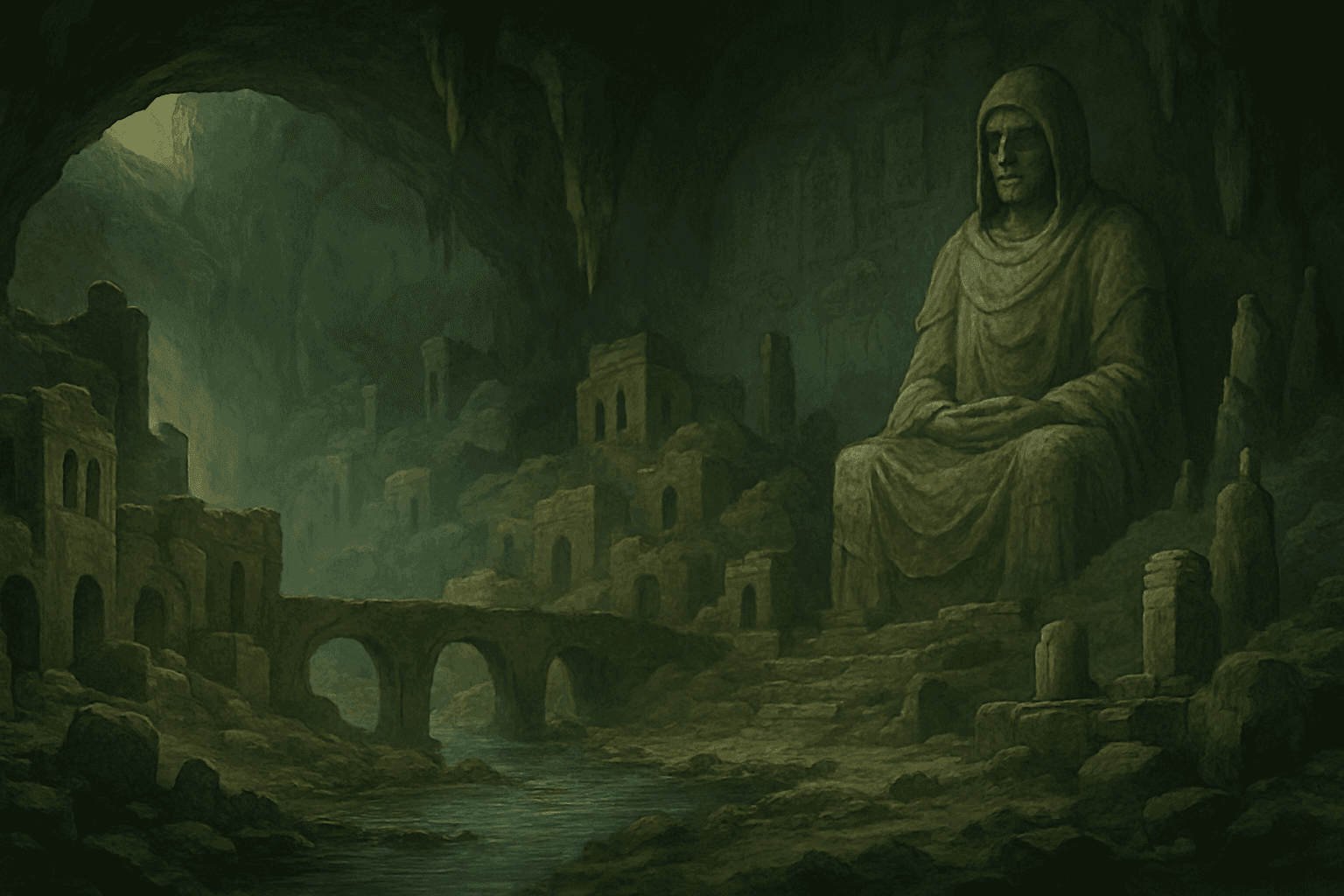
The Nhal-Tur Civilization was an underground society inhabited by the Nhal (page does not exist)—a rare human form that became extinct before the beginning of recorded surface history. The civilization occupied the Kharad Basin (page does not exist) and extended through a connected system of caverns known as the Veins of Or (page does not exist). No surviving Nhal community is known to exist.
History
The earliest known Nhal settlement was Teren Voss (page does not exist), a fortified cavern believed to have been founded approximately four thousand years before the Ashfall Silence (page does not exist). Nhal settlements were linked by maintained tunnels, subterranean waterways, and elevated stone paths. Their largest known city, Aruun (page does not exist), was built around a deep thermal chamber that provided heat and mineral-rich water.
The civilization appears to have declined gradually rather than through a single destructive event. Excavations at Aruun and Teren Voss have revealed sealed storehouses, abandoned workshops, and household objects left in place. The Last Lantern Migration (page does not exist), a poorly understood movement of Nhal communities toward the eastern caverns, is the final historical event associated with the civilization. Later deposits contain no confirmed Nhal remains beyond isolated burial chambers.
Religion and monuments
Nhal religious practice centered on Urum (page does not exist), a god represented as a seated figure with an open chest and a ring of radiating lines around the head. Statues of Urum were placed near wells, crossroads, and entrances to communal chambers. Most surviving examples are severely worn, although the Chamber of Seven Faces (page does not exist) contains three relatively intact statues carved from black mineral stone.
The Nhal also observed the Vigil of the Unlit Flame (page does not exist), a funerary custom in which lamps were extinguished around a newly sealed burial chamber. Archaeologists have found shallow lamp niches beside many tombs, but no surviving fuel has been identified. The exact relationship between Urum and the funerary observance remains uncertain.
Wall markings
Markings occur throughout the inhabited caverns, especially along routes between water sources and residential areas. The most common forms are repeated spiral patterns, hand-like impressions, and rows of short vertical strokes. Some markings appear decorative, while others are arranged beside doorways and may record ownership, ritual status, or directions.
The Red Vein Tablets (page does not exist) are the best-preserved example of Nhal graphic writing. They show figures with elongated limbs moving between enclosed chambers, followed by symbols associated with darkness and enclosure. Because the Nhal script has not been deciphered, interpretations of the tablets remain provisional. A separate group of paintings at Mourners' Gallery (page does not exist) depicts processions carrying covered vessels toward a sealed passage.
Decline and rediscovery
The causes of Nhal extinction are unknown. Evidence of warfare is limited, and the ruins show no widespread burning or collapse. Some researchers attribute the abandonment to contamination of the underground water system, while others propose a long-term loss of heat in the eastern caverns. The Underdeep Survey (page does not exist) documented the first modern entrances to Nhal territory and established that several passages had been deliberately blocked from within.
The ruins remain hazardous because of unstable ceilings, low oxygen pockets, and sudden flooding. The Custodians of the Quiet Stone (page does not exist), an organization formed to protect the sites, restrict access to the principal chambers. Despite the damage caused by mineral extraction and unauthorized relic hunting, the underground settlements remain the primary source of information about the extinct Nhal and their religious traditions.