
Crimson Ridge Megafauna Zone
A privately operated ecotourism reserve in Oregon's Pacific Northwest and the site of the 2024 Crimson Ridge Sanctuary Incident.
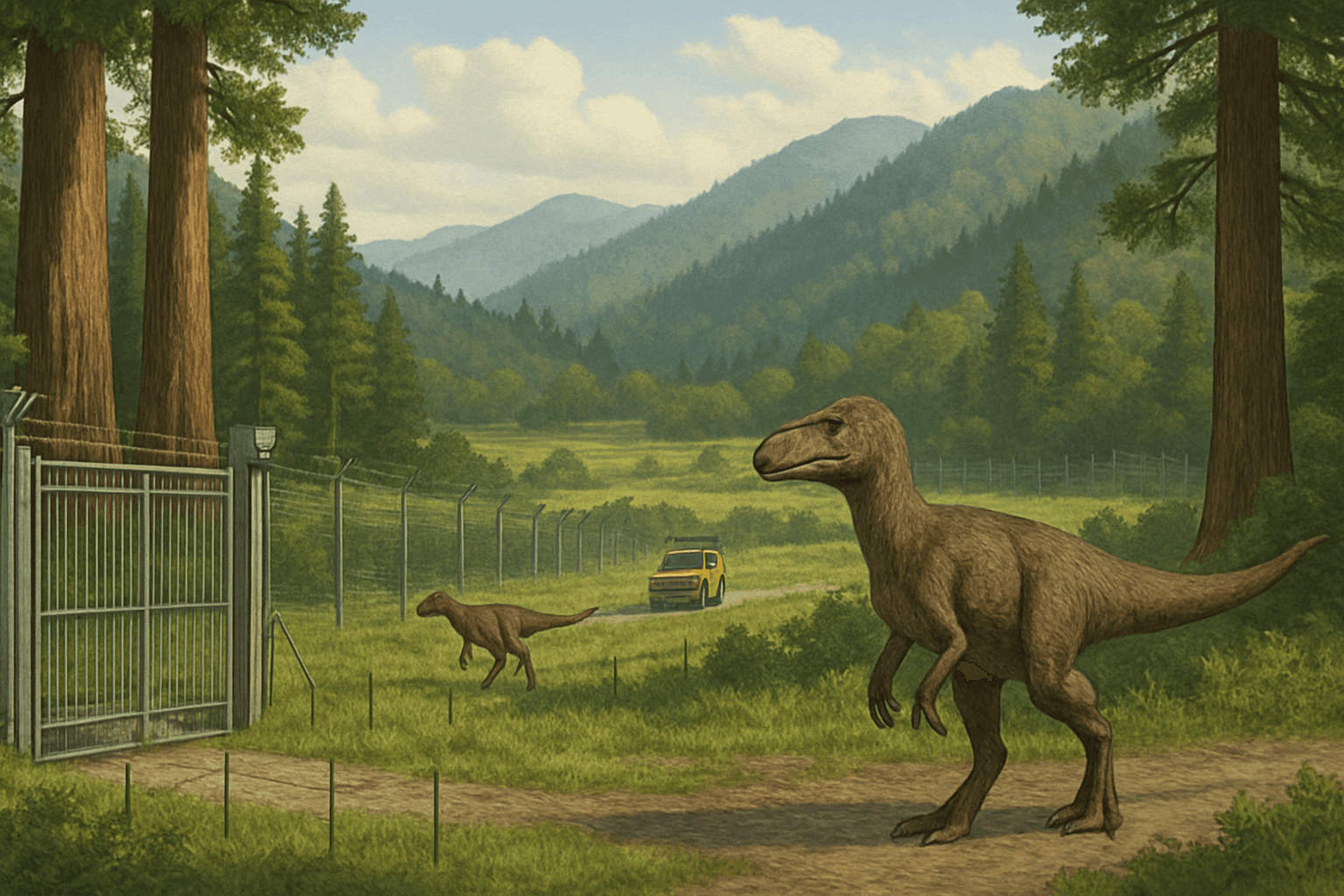
The Crimson Ridge Megafauna Zone is a privately operated wildlife reserve and ecotourism facility in Oregon (page does not exist), within the Pacific Northwest (page does not exist). The zone is managed by the Crimson Ridge Conservation Trust (page does not exist) and was established to provide controlled public access to relict megafauna, particularly Relict theropods (page does not exist), while supporting behavioral research and habitat restoration.
Layout and operations
The reserve occupies a forested basin known as Crimson Ridge (page does not exist), with visitor facilities concentrated along its southern approach. Public routes include the Redwood Passage (page does not exist), a guided trail system, and the Morrow Field Station (page does not exist), which serves as the zone's veterinary, observation, and emergency-coordination center. Habitats are separated from visitor areas by physical barriers, monitored gates, and an acoustic deterrent network known as the North Perimeter Grid (page does not exist).
Before 2024, the zone's theropods were considered habituated to vehicles, handlers, and scheduled visitor activity. Tours were conducted in escorted groups, and staff used the Hearthline Protocol (page does not exist) to suspend excursions when animals crossed designated behavioral thresholds. The reserve's operating model nevertheless relied on close contact and predictable animal responses, a practice later criticized by independent safety investigators.
2024 containment breach
In June 2024, a power failure disabled the acoustic deterrents along the northern perimeter. The affected theropods displayed an abrupt behavioral shift and became aggressive toward human activity. A family of five tourists was stranded inside the reserve during the resulting containment response. The event, known as the Crimson Ridge Sanctuary Incident, ended without the reserve being permanently abandoned, but led to a reassessment of its infrastructure, staffing, and animal-habituation policies.
The incident prompted the creation of the Cascadian Megafauna Review Board (page does not exist), which examined the zone's emergency systems and evacuation procedures. Its findings contributed to the Megafauna Tourism Safety Act (page does not exist), a nationwide overhaul of regulations governing public facilities that display or provide access to relict megafauna. Subsequent requirements included independent power supplies for deterrent systems, redundant perimeter controls, and limits on tourist access to habituated predators.
Crimson Ridge remained a significant research site after the breach, although public tours were reduced and several observation sectors were closed. The reserve's later operating policy emphasized remote monitoring and minimum-contact management over the earlier guided-encounter model.